
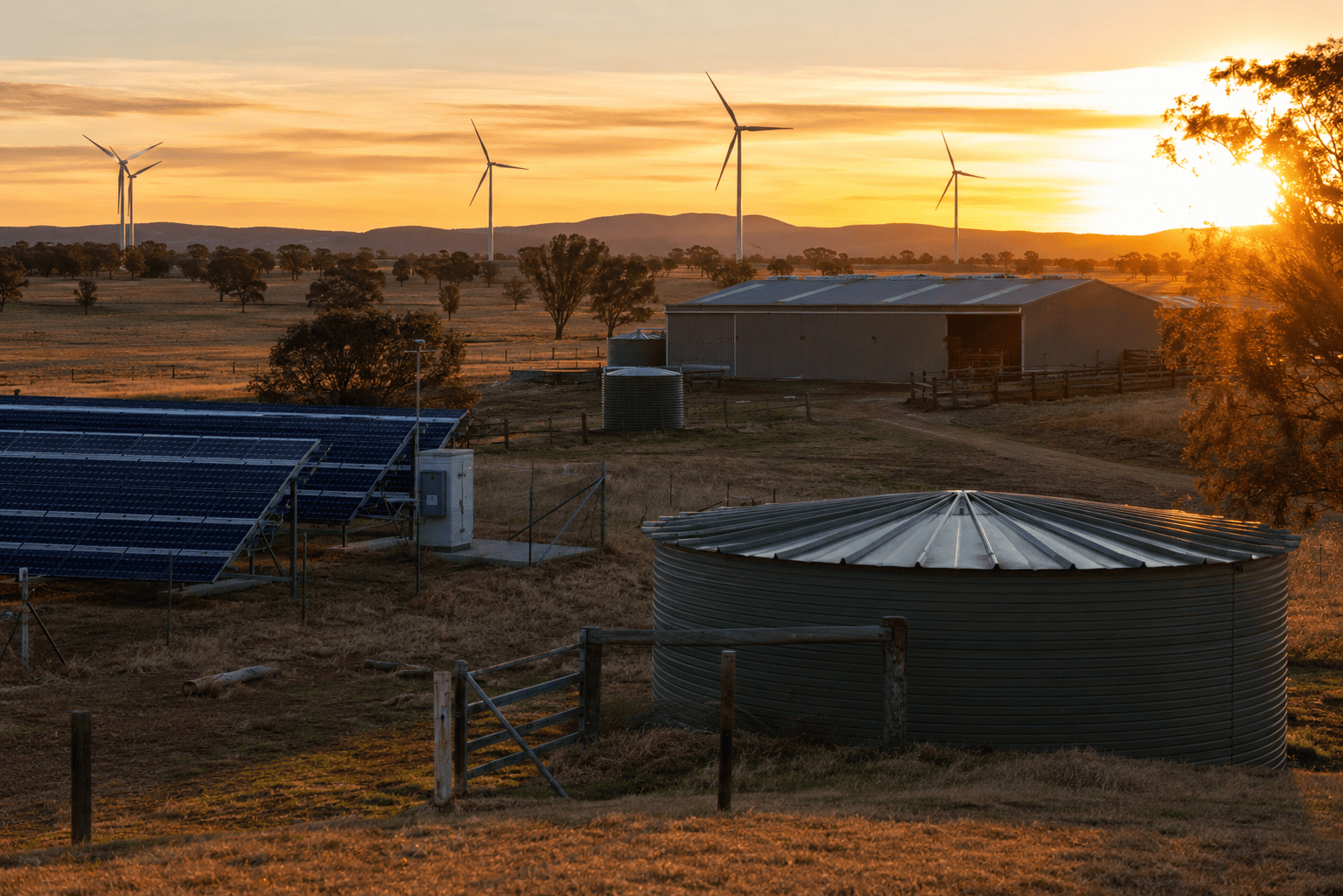
Regional Australia is not on the edge of the energy transition. It is right at the centre of it.
When people talk about renewable energy in Australia, the conversation often turns to solar farms, wind farms, batteries and transmission lines. Many of these projects are located outside capital cities, across farming districts, coastal regions, inland corridors and industrial towns. That is because regional Australia has the space, natural resources and energy demand needed to support the next phase of the national electricity system.
The simple answer is this: regional Australia matters to renewable energy because it is where much of Australia’s clean energy will be generated, stored, managed and used.
But the story is bigger than land availability.
Regional communities already play a critical role in Australia’s economy. They produce food, fibre, minerals, manufactured goods and exports. These industries need reliable, affordable electricity to stay competitive. As energy costs rise and reliability becomes more important, regional businesses are increasingly looking at solar, batteries, smart energy management and other distributed energy resources to take greater control of their energy future.
This shift is changing the role of regional energy users. Farms, processing facilities, cold storage operators, manufacturers and local councils are no longer just passive electricity customers. Many are becoming active participants in the grid. A dairy farm with solar and battery storage, for example, can reduce its own costs, support local network stability and provide backup power during outages. Across many sites, these systems can help strengthen regional electricity networks.
The challenge is that many regional networks were not originally designed for large volumes of two-way electricity flow. Traditional grids were built to move power from large generators to customers. Today, electricity is increasingly being produced at thousands of smaller sites. This creates new planning challenges, including voltage issues, export limits, congestion and the need for better local coordination.
That is why regional energy investment needs to be smart, not just large. New transmission will be important, but so will technologies that make better use of the infrastructure we already have. Batteries, smart inverters, demand response, energy management systems and virtual power plants can all help unlock more capacity in regional networks.
The future of the regional energy transition will depend on more than building projects. It will depend on building trust. Communities need to see practical benefits: lower costs, greater reliability, local jobs, greater resilience, and fair participation in the value being created.
Regional Australia should not be viewed simply as a place to host renewable energy infrastructure. It should be recognised as a major energy partner.
That partnership will shape whether Australia’s energy transition is fast, fair and reliable.